
Protected: still adjusting
•October 30, 2013 • Enter your password to view comments.Protected: two
•August 29, 2013 • Enter your password to view comments.Protected: breakdown, breakthrough ~ part two
•July 22, 2013 • Enter your password to view comments.Protected: breakdown, breakthrough ~ part one
•July 18, 2013 • Enter your password to view comments.four
•May 30, 2013 • 14 CommentsMinutes before the day is new … midnight ~
Four years since the day she was born just after dawn ~ not yet ours though our hearts burst with love for this unbelievably magnificent child, and the amazing young woman who brought her into the world.
Four years ago we welcomed our daughter as a universe of love surrounded her. We were forming a new family ~ a beautiful one that defied and yet would be inextricably linked by blood, one that was chosen.
Four years ago I became a mama when this precious child was entrusted to our care ~ and every day since I have felt such enormously humbling gratitude.
From brand newborn to adorable baby and curious toddler, now in preschool and next year Kindergarten, our sweet girl is growing into such a marvelous little person ~ smart, clever, funny, creative, kind, sweet and strong. It will always be my privilege to share this life with her, to help guide her to become the person she is.
 Anyone who remembers Jaye’s birth story may remember a labyrinth or two. Here’s Jaye at the middle of her own.
Happy 4th birthday, sweet Jaye ~ you make the world a brighter and more lovely place. We love you forever and ever and always!
open hearted open adoption: book tour
•May 9, 2013 • 11 CommentsWelcome to my stop on the book tour for our own Lori Holden’s book, The Open-Hearted Way to Open Adoption.
I sang the book’s praise when it first arrived in the mail last month, with a certain thrill and sort of fear at seeing my words in black and white, on paper, when I flipped the book open to chapter one. By chance I landed on a page containing an excerpt from I post I had written over four years ago, just before our daughter was born, before she was “ours.” It was about letting go of fear and insecurity and embracing possibility and vulnerability. Ultimately that post was about opening one’s heart.
I wish I could explore all of the questions proposed by participants on this book tour. Though I planned to answer more, I only had time for two since my answers are long! Click through to see what others are saying about Lori’s book.
Holden encourages adopted parents to embrace an and/both mindset instead of either/or thinking, through a careful process of fostering connections of an adopted child to both first parents and adopted parents. Why do you think this approach helps a child “grow up whole?”
Excellent question. While I’d love to speak with authority on this one, our child is not even four years old and is only now beginning to ask questions about her story. But this approach just makes sense. Lori’s fundamental premise: that adopted children grow up with a split between their biology and biography, and that openness can help heal that split. Openness in spirit — i.e., talking about adoption, celebrating the child’s origins, embracing their first families, acknowledging loss, etc. — can help a child integrate these two fundamentally different aspects of themselves.
A child is born into one family, then raised by another. The child remains part of both families. Yet there’s a disconnect. The child’s first/birth family is still very much a part of the child. And the child is still part of that family, even though s/he’s not there. At the same time, the child is embraced into his/her new family and loved and cherished. Yet all the love in the world can’t make up for what the child has lost — i.e., the opportunity to grow up in his/her family of origin. It’s the one thing I can’t give our daughter, that experience. As full as her life may be, something is inherently missing. But I can help facilitate a connection to that sense of herself. When I embrace our daughter’s first family into my heart, I’m loving a part of her. When we embrace them into our lives, they become our family too.
My daughter didn’t choose to be adopted. The rest of us made that choice for her. She shouldn’t have to choose between her two families, where to place her love or loyalty. She shouldn’t be forced to feel a split in her identity, divided. She is not either part of their family or part of ours. She is both. Always both.
Of course I’m her Mama. And I can’t say it won’t hurt when she tells me I’m not her “real” Mama. But she has another Mama, too. That bond never ends, the love never stops. No one wins if we force her to choose, to pretend she exists in just one family. Most of all, she loses an important part of herself. Our daughter is both the result of her nature and nurture. We can help integrate these two vital parts of her identity. Openness takes away nothing from me, once I acknowledge there are certain things I simply cannot provide. Yet it could mean everything to our daughter, in that her first/birth family is a vital part of who she is. By embracing her birth family as extended family, our daughter shouldn’t ever have to choose between us. She may feel loss, but she should never feel split. Her love should not be divided but rather multiplied. Love is not finite or limited. There is enough to go around. She has a right to feel and express it all, and it’s our job as her parents to provide those opportunities.
As Lori wisely says in a recent post, shifting to a “both/and” paradigm properly puts the child first. “We encourage them to claim all pieces of themselves, those from biology and those from biography. We enable our children to be claimed by both of their clans.” An adult adoptee friend puts it more simply: “Not half and half…both things. The two parts are not mutually exclusive nor inclusive. Not 1+1=0…but rather 1+1=1.” She further illustrates the point with this example: a mother with two children is not half a mom to each, but a full mom to both; similarly, adoptees exist in both families at once.
Adoption was once associated with secrecy and shame. Like a dark secret hidden from view, negative emotions can fester beneath the surface which can cause problems later. As Lori writes, openness can help shine a light on that darkness, calling it out, validating those feelings and naming them. Trust and open communication about adoption can help a child approach his/her parents to discuss tough issues in a safe and supported setting, rather than feeling stifled. While we can’t take away or “fix” our children’s negative feelings, we can hold them close and affirm them and help them release those feelings so they don’t insidiously gain power and influence over their hearts and minds.
To me, that’s how openness helps heal. It places the child first, always, even (especially?) when it pushes us beyond our comfort zone. It broadens our definition of family. It supports our children as they work through what it means to be adopted. It helps them claim their full identity, as part of both families. And it means they never have to choose.
Lori talks about her journey as an adoptive mom from initially feeling threatened at the prospect of openness to embracing it as a way to help her children be whole. How important do you think her experience during adoption school (when she was ‘the baby’) was to her process?
The short answer: a little empathy can go a long way.
I can’t speak to Lori’s process, but I can imagine that in those moments — where she imagined what it was like to have been “the baby” separated from the only mother she ever knew — engendered great empathy. Lori’s heart was open enough to get outside her own skin and limited experience, to ponder the heart and needs of the baby. And that’s how we put children in adoption first. We focus on their needs, from before they are born and throughout life. [EDITED to add: Of course all parents ideally do this, adoptive or not. Yet parents through adoption have an unique set of complex issues and relationships to navigate in parenting, which warrant special attention and care.]
I know during our process, my heart opened to embrace openness farther and faster than I could have imagined before. Yet there is a difference between approaching openness objectively — i.e., envisioning it in theory — and subjectively — i.e., living it daily. I can be logical and analyze why openness would be beneficial, but nothing could really prepare me for those intimate moments, sitting with my daughter and telling her how she came to be ours. That’s not to say I shouldn’t have prepared for those moments — because I did, I practiced and started telling her story long before she could ever understand, for instance. Yet in those moments, looking into her bright eyes and feeling the weight of her body against mine as she seeks little bits of information, only that which she is ready to hear and saving the rest for another time, in those moments I want to hold her tight and wipe away the hurt, even the hurt she might not yet feel because the magnitude of her story has not yet been processed. But I know I can’t.
Instead, my job is to hold that space for her to feel and process whatever emotions arise. It’s acknowledging that the day I gained a daughter, she lost a mother. Even as her birth mama remains an integral part of her life, our daughter lost the chance to grow up in the same home. Loss is loss. Acknowledging this validates her experience.
In those moments, I am so grateful for the relationships we have with our daughter’s first family, and I hope and wish and pray they remain strong for her sake. I wonder how accessible her birth mama will be as our little girl grows up and her questions (and understanding) grow more complex. I think about her biological father’s side of the family, and I wonder whether there will ever be more, and quite honestly, I worry about it either way. I think about how one day, she will explore such profound questions and deep issues so core to her very identity. I try to imagine her head and heart trying to grasp the reality of having been adopted, of being adopted. And all I can do in those moments is remember to breathe, open my heart a little more, and let it grow to make room for all of it.
Empathy above all is a quest for understanding. While I can never truly understand what it means to be an adopted child, I can seek understanding by opening my heart to our daughter as she discovers and experiences what it means for her. When I focus on her, everything becomes more clear. This is true now, just as it was before she was born. When I could set aside my longing to become a mama and focus instead on the well-being of the child yet-to-be-born, her interests and needs came first and it became clear what I needed to do. I can only hope the same internal compass will guide me as she grows, along with her understanding of her own story.
18 months, adjusted
•April 17, 2013 • 8 CommentsI suppose it’s no surprise that I’ve found it so difficult to write about my girls here. What once began as a blog about infertility and loss sort of shifted to adoption, parenting and openness, then morphed into unexpected high-risk pregnancy and life with a preemie and now as an older mama of two amazing children with their own individual stories, which I try not to share here.
Like our girls, I suppose this blog has its own unique story, too.
It’s not that I don’t want to write about my kids, really. While I know that some passing through on their journey might find it difficult to read about parenting — I know I did, at times — I’ve always known that I needed this space to process my thoughts and experiences, and I’ve tried to be sensitive. It’s partly that I’ve tried to respect my family’s privacy by not sharing too much, especially the parts that are not mine alone. Plus I have a far too neglected family blog at which I can share stories and photos for loved ones, though I haven’t updated it in ages (because I’m a bad blogger). And let’s face it, I’m pretty exhausted from caring for a high-needs infant and very energetic preschooler at age 43 (almost 44!), while trying to make room for a few hours of work when I can get it.
Sometimes though, it’s because I can’t find the words. Or I’m not ready to utter them. Or I haven’t yet processed the thoughts to articulate the words and commit them to writing.
Today Baby Z is 18 months old, according to her adjusted age; she is actually closer to 20 months, given her birth date. I still balk when someone asks how old she is, not knowing whether to explain the fact of her size or abilities for her age. Sometimes when I share her actual age I add “she’s small” or “she was early” and sometimes I don’t. Eventually I won’t feel the need to.
Like her big sister, Baby Z is an amazing light force in our family. Her eyes smile when she’s happy, her laughter is infectious, she is affectionate and adored by all who meet her. I can’t even explain how this experience has affected me — i.e., this privilege of having a second child after giving up all hope of a sibling for Jaye, and a chance to do it again. It is beyond measure, how blessed I feel to have this baby in our lives.
Yet she is also what we’d call a “high-needs” baby. She has never been a good sleeper, though thankfully she wakes less often now than before. While she is now on the charts for size, she has never been a great eater, to the point where she begs for snacks after meals, refuses to eat foods that touch each other, and wakes hungry in the middle of the night. Her cries are more like urgent demands and can be tough to soothe. If her routine is upset, so is she. She is super sensitive to different touches and textures (see also picky eater). And oh, is she stubborn. Not that we expected anything different, under the circumstances. This last trait she shares with big sister too.
As can be expected with a preemie, she has experienced some developmental delays. While we’ve been extremely fortunate that she hasn’t had major issues with lungs or eyes or other conditions common to prematurity, some delays have posed certain challenges. She was slow to roll and sit and didn’t crawl until nearly a year. Her crawl is really more of a “scoot” and has been for about 8 months. So while her muscle tone seems OK, her core is underdeveloped which impacts her ability to stand or walk for any length of time. Only now at nearly 20 months has she really started trying to walk, and she’d rather scoot as she can move quickly that way. And while I do love holding this baby — and I do love how long she’s been a “baby” — it really is time for her to start getting around on her own better. Her lack of mobility has fostered a strong dependence.
Her speech too has been delayed. Unlike big sister who had a substantial vocabulary and was forming sentences by this age — not that comparison is valid, given that each child is different and they don’t even share genetics — little sister barely has a handful of words and she doesn’t really use them. She mainly communicates using a few signs, by pointing and vocalizing, and by crying and screaming. Her reception and comprehension are just fine. She understands a lot. But her expressive abilities are limited which causes frustration for everyone.
While I’d been worried about the lack of progress, I told myself there would be no real cause for concern until she turned 18 months. Some doctors said she should be caught up by one year, others said two. So I went with 18 months, a milestone age for walking and talking. And yes, I know some kids don’t talk until age two, but given her history I was concerned and early intervention is best. So, 18 months. But which 18 months? Actual or adjusted?
Our girls have twin cousins who were born just days before Z. Our niece also had a high-risk pregnancy and we texted and chatted during our bedrest. We each delivered by c-section just three days apart. Her twin girls, born at nearly 37 weeks gestation, were bigger than Baby Z at birth (who was born at 33w3d). These girls have been walking since 9-10 months, which is literally half of their short lives. I know that’s early, but still. We had the pleasure of spending the girls’ 18 month birthdays together, the first time all four girls met in person. We had a blast, yet it was interesting to note the stark differences in the babies. When we came home I was resolved to get Z the support she needed and after her 18 month check-up I made some calls. The result: four appointments in a one-month period including three evaluations (speech, PT and neurological) and an assessment by a wonderful local agency that would provide services at no cost if she qualifies based on the extent of her delays.
Already I’m relieved that she has made so much progress walking since that first phone call and evaluation. She seems stronger every day and better able to take those first confident steps. The physical therapist gave us some tips to strengthen her weaker side, as well. We haven’t had as much progress on the language front, however. On one hand she seems sort of stalled in her ability to sign and speak and I was concerned about regression. Yet she continues to learn new words every day and her comprehension is remarkable. And we’re getting good tips from the therapists, even though we’re only in the evaluation stage.
I would like to believe that Baby Z is merely experiencing a normal delay, that she will get support and catch up and eventually be just fine. Yet I know there is a possibility for some long-term effects or some more insidious problem. Either way, she is an incredibly resilient child, not surprisingly. And I suppose we’ve grown pretty strong too.
So there it is. I imagine we’ll know more soon. Time will tell.
open-hearted open adoption: read this book
•April 4, 2013 • 5 CommentsI can’t tell you how proud I am of my friend Lori, whose wonderful book about her open-hearted approach to open adoption is finally available!
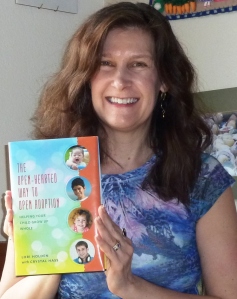 Photo credit: LavenderLuz.com
Seriously, this book is wonderful. More than a “how-to” manual, it gently guides the reader to his/her inner compass towards an open heart, which is essential for true openness in adoption — and by “openness” I mean of heart and mind, and in spirit. It shows how openness is not merely about the exchange of information or extent of contact; it’s about connecting through love for a child. Through first person perspectives and invaluable storytelling, it demonstrates why and how openness benefits adopted children and their families. The book shares with truth and candor how families can and do extend and blend beyond blood to include the bonds of love and trust.
If you are considering adoption (domestic, foster or international), if you have placed a child for adoption, if you or someone you love has adopted or placed a child, or if you work with people considering adoption, please consider reading this important book. Because it focuses on openness in spirit and approach, it is relevant even for those building families through donor gametes, where biology is not shared among parents and children.
I seriously think this book is a must read for anyone connected to adoption. I only wish it had been around about five years ago when I started reading everything I could about openness. I would have devoured it!
Lori has been hard at work on this for a long time. I know this because she interviewed me 3.5 years ago, after we granted permission to share part of our adoption story. Along with many other poignant stories, ours is featured as an example of how to cultivate a genuine spirit of openness in adoption.
While we were willing to share aspects of our story, there is a certain surrealism in knowing that thoughts and words uttered here in my personal (though not private) journal would be shared with a broader audience. And perhaps a certain fear too. I blog under a pseudonym to protect not only my privacy but that of my family. While I love to discuss adoption, and our experience in particular, I am essentially bound to guard my daughter’s story until she may do so herself one day. I’ve taken great care to protect her privacy as well as her family of origin’s. So when I came to the realization that part of our story would be forever memorialized in black and white and packaged for a new audience, I was excited but understandably a bit nervous…

I think it’s appropriate that this particular excerpt from Chapter One, from a post written four years ago, was about love and fear. I literally opened the book the moment it arrived and opened to this page. When I tweeted this, Mac laughed because we both know it wasn’t the act of seeing these words in black and white that made them “real.” Certainly living them was The Real Thing. Writing those words the first time was Real. Reading them again now? Well it seems like a lifetime ago. But deep down I know that everything I processed here in these pages, all that thinking and writing and sharing and dialogue helped build the foundation for my approach to openness and parenting in a very open adoption. Reading Lori’s words helped shape that approach too.
We are so honored to be included in this fantastic collection of family stories about openness in adoption, this wonderful guide to opening your heart to act from love rather than fear.
Bravo Lori, and kudos to you, my friend! Well done.
the power of storytelling
•March 19, 2013 • 3 CommentsThere have been a wonderful flurry of bits about a recent New York Times article about the significance of storytelling in families.
As personal bloggers, I think most of us can appreciate the value of telling our stories. It’s cathartic and therapeutic. It helps us process and make sense of life events and challenges. Sharing connects us to others with similar experience. Documenting our stories leaves a mark, perhaps even a signpost for those who might pass through later.
We also know that storytelling can enrich the lives of children, cultivating imagination with a sense of wonder. It sparks creativity with visions of worlds beyond their own.
Yet it seems that storytelling serves other critical functions for children, as well. Telling children your family story can build self-esteem, teach conflict resolution, model resiliency, and offer a sense of control over their lives while connecting them to something bigger and stronger than themselves. According to the article, “The single most important thing you can do for your family may be the simplest of all: develop a strong family narrative.”
Learning about one’s family history can help a child make sense of the world and his/her place in it. It’s what sociologists refer to as “sense-making, the building of a narrative that explains what the group is about.” Yet stories also offer tools to cope with everyday challenges and traumatic events. A team of psychologists asked children a series of “do you know” questions (about their parents and grandparents, their birth, etc.) and concluded: “The more children knew about their family’s history, the stronger their sense of control over their lives, the higher their self-esteem and the more successfully they believed their families functioned.” In fact, they determined that historical family information was “the best single predictor of children’s emotional health and happiness.”
In our family, we tell a lot of stories. We tell stories at the table, in the car, on long walks, at bedtime. We talk about how each of our girls came to be with us and how we came to be with each other. We weave in key characters, like Jaye’s birth family members, acknowledging their place in our family. We talk about those no longer with us. And we make room for new stories, every day.
With adoption, this notion of telling stories is critical. I think it’s fundamental to our daughter’s well being — i.e., her sense of belonging, of knowing who she is and where she came from and how loved she is by all. Jaye in particular comes from a long line of very strong women and she holds a significant place in her family of origin as well as her family through adoption. The act of listening, of telling and re-telling our family story is how she may begin to integrate her personal story — which inevitably diverges from ours because it is hers alone. Telling her story is how I hope to help her feel whole so she never has to choose one part of her life over another, or what my friend Lori calls her biology and biography. The storytelling theory clearly relates to a certain appeal of openness in adoption, in that we try to help our children make sense of their history, their stories, as we write our own together as an extended blended family.
The author suggests that for a “happy” family, you should “create, refine and retell the story of your family’s positive moments and your ability to bounce back from the difficult ones.” I can’t say with certainty that telling our family story will offer our daughters anything more than information. But if we can impart important life lessons, confidence and self esteem, a sense of belonging and utility; if we can help our children overcome challenges with strength, resilience and resolve, well then that’s as good as any reason I’ve ever heard to tell a good story.
what openness means to me (so far)
•February 19, 2013 • 10 CommentsI wrote my last post in response to a recent conversation about adoption. I hung up the phone frustrated and just had to write, though I deleted the part where I vented said frustration since it wouldn’t do any good to publish it. I ended up going in a different direction which was far more civil though sterile (and long, sorry). Something was lost, I think, in my effort to avoid the controversy I would have been courting by publishing the original. Maybe some day I’ll feel more comfortable writing more about that particular situation. Maybe not.
For now, I just want to try to address the spirit of what was missing in that post.
What is openness to me?
Openness is embracing our child’s first family as our own. It’s extending our family to include those who loved our daughter before we ever met her. It’s expanding the very definition of family, not just in theory but in every day practice.
Openness is telling our daughter the story of how we came to be her parents. It’s never needing to choose the “right” time to tell her about adoption, because she will always know. It’s creating an environment where she should feel comfortable asking hard questions and sharing difficult feelings. It’s being honest and authentic, always.
Openness is being able to see where our daughter got her magnificent locks and luminous eyes. It’s seeing her face light up as she sits next to her kin while they gaze into a mirror admiring their likeness. It’s celebrating those similarities and their source.
Openness is knowing where our child inherited her unique artistic ability and uncanny memory. It’s listening to stories that tie our daughter to her ancestors, and re-telling those stories until they become her own.
Openness is genuinely extending a warm welcome into our lives, not an obligation we fulfill because a contract says so. It’s reaffirming that invitation when someone may need encouragement to participate. It’s keeping that door open for those who have not yet walked through it.
Openness is tremendous gratitude that our daughter can share significant milestones as well as ordinary events with family who love and adore her. It’s witnessing the love flowing to and from our little girl. It’s enjoying regular meals with her grandmother. It’s when her grandfather drops off a valentine on his way home from work. It’s always planning our next visit, hoping it comes sooner rather than later.
Openness is when our oldest daughter’s first family embraces our youngest daughter too. It’s knowing that family ties are built with dedication, commitment and love that extends beyond blood, woven into a rich tapestry displaying many stories, bold and beautiful, heartbreaking and marvelous.
And that is only the beginning…







 life from here: musings from the edge
Recent Comments